



AI Strategy and Adoption Roadmap for a Real Estate Agency
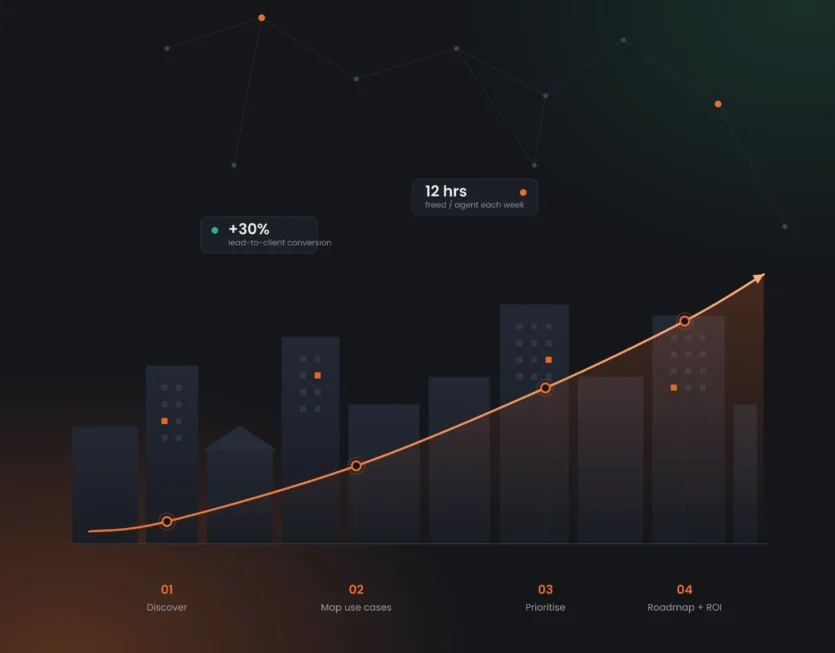
Objective: A mid-sized residential real estate agency approached us aware that competitors were adopting AI, but unsure where it actually fit their business — and wary of disrupting how their agents work. Our objective was to deliver a clear, costed roadmap identifying exactly where AI would create measurable value across lead generation, property valuation, and client experience, in what sequence, and at what investment level.
Methodology: We started with the business and its data, not a tool.
Our advisory process combined:
- Discovery and Data Audit: Interviews across sales agents, property management, and marketing, paired with a review of CRM records, listing history, and lead-pipeline data to assess quality and readiness.
- Use-Case Mapping: Every candidate AI application — buyer/seller lead scoring, automated property valuation, 24/7 enquiry response, suburb-level price forecasting, and listing/document automation — scored against business impact and implementation feasibility.
- ROI Modelling and Prioritisation: Cost, timeline, and expected return estimated for each use case, then sequenced into phases starting with a fundable quick win.
- Roadmap and Governance: A 12-month phased plan with clear ownership, success metrics, and a lightweight governance model to keep delivery accountable.
This ensured every recommendation tied back to a commercial outcome before any build began.
Solution: We delivered a prioritised, costed AI adoption roadmap that moved the agency from “We should try AI Consulting” to a sequenced plan with defined ROI. Phase one focused on AI-driven lead scoring and 24/7 automated enquiry response — ranking incoming buyer and seller leads by intent so agents spend their time where deals actually close, and ensuring no after-hours enquiry goes cold. We also provided a data-readiness action list and a governance framework so the agency could execute confidently and measure results against agreed targets.
Impact:
- Lead-to-client conversion lifted from around 6% to over 11%: Scoring and routing enquiries by intent nearly doubled the rate at which leads became clients.
- Around 12 hours freed per agent each week: Automating routine lead qualification returned roughly $60,000 in annual productive capacity per agent, redirected to showings and closing.
- Valuations in minutes, not hours: The recommended valuation approach cut turnaround dramatically while tightening accuracy towards a 3–5% error range, versus the 10–15% typical of manual estimates.
- Wasted spend avoided: Budget was steered away from low-impact tools and towards the response-speed and lead-scoring use cases that demonstrably drive deal volume.
Technologies and Frameworks: AI use-case prioritisation matrix, data maturity assessment, predictive lead-scoring models, automated valuation (AVM) techniques, Python, Power BI / Tableau, cloud platforms (AWS / Azure), and CRM integration.
AI use-case prioritisation matrix, data maturity assessment, predictive lead-scoring models, automated valuation (AVM) techniques, Python, Power BI / Tableau, cloud platforms (AWS / Azure), and CRM integration.